From methane to solid carbon
As we saw in our previous blog post, hydrogen has the potential to become the fuel of the future, since the only thing it releases when used is water. The catch is that, today, hydrogen is mostly produced from natural gas, and every kg of hydrogen produced emits between 9 and 14 kg of CO2.
Projects like ours can stop that carbon from escaping into the air as a gas by turning it into solid carbon. But what exactly is solid carbon?
What is solid carbon?
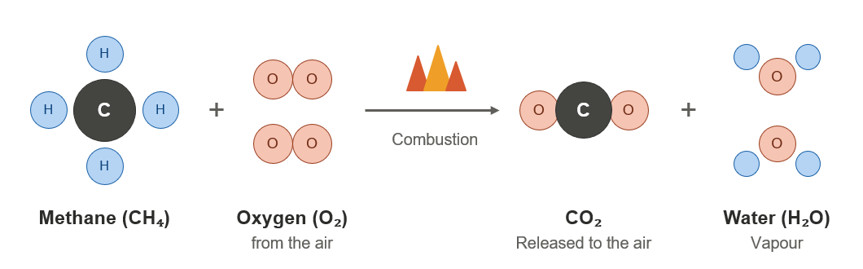
It is carbon in the form of a black powder, obtained by breaking apart the methane molecule. As its formula shows, methane (CH4) is made up of one carbon atom and four hydrogen atoms. When methane is burned, the carbon bonds with the oxygen in the air to form CO2, a greenhouse gas.
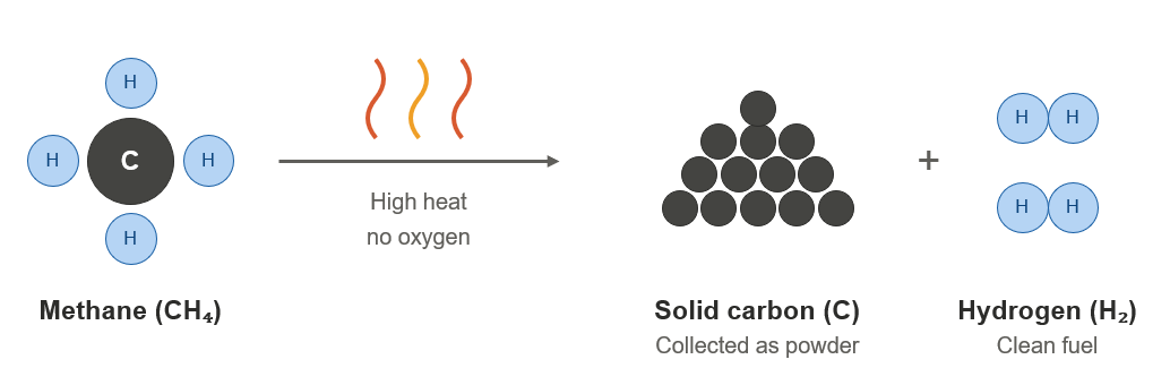
However, if methane is heated to very high temperatures in the absence of oxygen, it splits into two parts: hydrogen (H2) gas on one side and carbon (C) on the other. This process is known as methane pyrolysis.
Why does it matter?
For many reasons, but here I’ll give you the two main ones.
On the one hand, it’s about generating a useful material instead of waste. That black powder has value. Selling it as a raw material avoids having to produce that same carbon through polluting methods, such as the partial combustion of petroleum derivatives.
On the other hand, we are obtaining carbon of renewable origin. If the starting methane comes from organic waste (biomethane) rather than fossil gas, the resulting carbon is biogenic. In other words, it replaces fossil carbon that would otherwise have to be extracted from underground (a finite resource).
What is it used for?
Well, that largely depends on the process used to obtain it, since some solid carbon is of higher quality than others. This quality doesn’t make one carbon better than another in absolute terms but, for example, a carbon that works well in a blast furnace may be a poor fit for a tyre, and vice versa. Even so, in economic terms there is a fairly clear value scale, determined by how the carbon is organized internally and by its physical and chemical properties.
Based on its internal structure (from lowest to highest value):
- Amorphous carbon: the atoms are disordered.
- Carbon black: very fine particles with a controlled structure.
- Graphite, graphene and nanotubes: the atoms are perfectly ordered in layers or tubes.
As for its physical and chemical properties, these depend heavily on the industrial use it is intended for. For example, in the case of PYRAH2, Goodyear will assess its characteristics to see whether it is functionally equivalent to an ASTM tyre-grade carbon black, while ArcelorMittal will look at other qualities for different steelmaking uses, such as replacing metallurgical coke or as a carburizing agent, because yes, you may not know it, but steel is iron with a small amount of carbon, and today, this carbon is mostly fossil, with all the environmental impact that entails.
Now, let's be honest.
Solid carbon has all these qualities, but there’s more: methane pyrolysis splits methane into hydrogen and solid carbon without direct CO2 emissions and with much lower electricity consumption. Just imagine: PYRAH2 aims to consume less than 15 kWh of electricity per kilo of hydrogen, compared with around 50 kWh for electrolysis.
If you want to learn more about this side of hydrogen, stay tuned, because we’ll be talking about it in more detail soon.